English
 русский
 español
 português
 العربية
 China
China



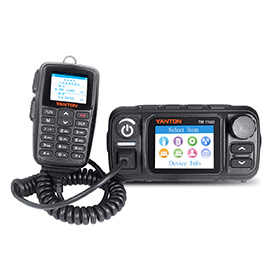

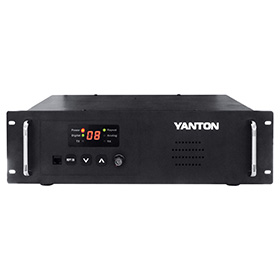


What is a GMRS Mobile Radio? It's a fixed, vehicle-mounted radio that operates on the General Mobile Radio Service (GMRS) frequencies. It's much more powerful (typically 15W to 50W) than a handheld GMRS radio (typically 5W-8W), giving you significantly greater range and a more robust antenna system. Key Advantages Over Handhelds Power: 15W to 50W output vs. 5W-8W on a handheld. This directly translates to much longer range. Antenna: A permanent, roof-mounted antenna (like a 1/4 wave or 1/2 wave) is far more efficient than a tiny handheld antenna. This is the single biggest factor in improving performance. Audio: Loud, clear external speaker and a good microphone. Durability: Built for continuous use in a vehicle environment. Convenience: Dedicated controls, easy to use while driving, no battery charging. Who is a GMRS Mobile Radio Best For? Overlanding & Off-Roading Groups: The #1 use case. Staying in contact on trails. RV & Caravan Families: Coordinating between vehicles on road trips. Event/Volunteer Communications: For organized events where CB is too crowded or short-range. Farm/Ranch/Property Communication. Preppers & Emergency Comms: As a reliable backbone for vehicle-to-vehicle or via repeaters. Official GMRS Frequency Table Channel Frequency (MHz) Power Limit Notes 1 462.5625 5W Shared with FRS, narrowband only (FMN) 2 462.5875 5W Shared with FRS, narrowband only (FMN) 3 462.6125 5W Shared with FRS, narrowband only (FMN) 4 462.6375 5W Shared with FRS, narrowband only (FMN) 5 462.6625 5W Shared with FRS, narrowband only (FMN) 6 462.6875 5W Shared with FRS, narrowband only (FMN) 7 462.7125 5W Shared with FRS, narrowband only (FMN) 8 467.5625 0.5W Shared with FRS, narrowband only, low power only 9 467.5875 0.5W Shared with FRS, narrowband only, low power only 10 467.6125 0.5W Shared with FRS, narrowband only, low power only 11 467.6375 0.5W Shared with FRS, narrowband only, low power only 12 467.6625 0.5W Shared with FRS, narrowband only, low power only 13 467.6875 0.5W Shared with FRS, narrowband only, low power only 14 467.7125 0.5W Shared with FRS, narrowband only, low power only 15 462.5500 50W Repeater Input (when used with +5 MHz offset) 16 462.5750 50W Repeater Input (when used with +5 MHz offset) 17 462.6000 50W Repeater Input (when used with +5 MHz offset) 18 462.6250 50W Repeater Input (when used with +5 MHz offset) 19 462.6500 50W Repeater Input (when used with +5 MHz offset) 20 462.6750 50W Repeater Input (when used with +5 MHz offset) 21 462.7000 50W Repeater Input (when used with +5 MHz offset) 22 462.7250 50W Repeater Input (when used with +5 MHz offset)
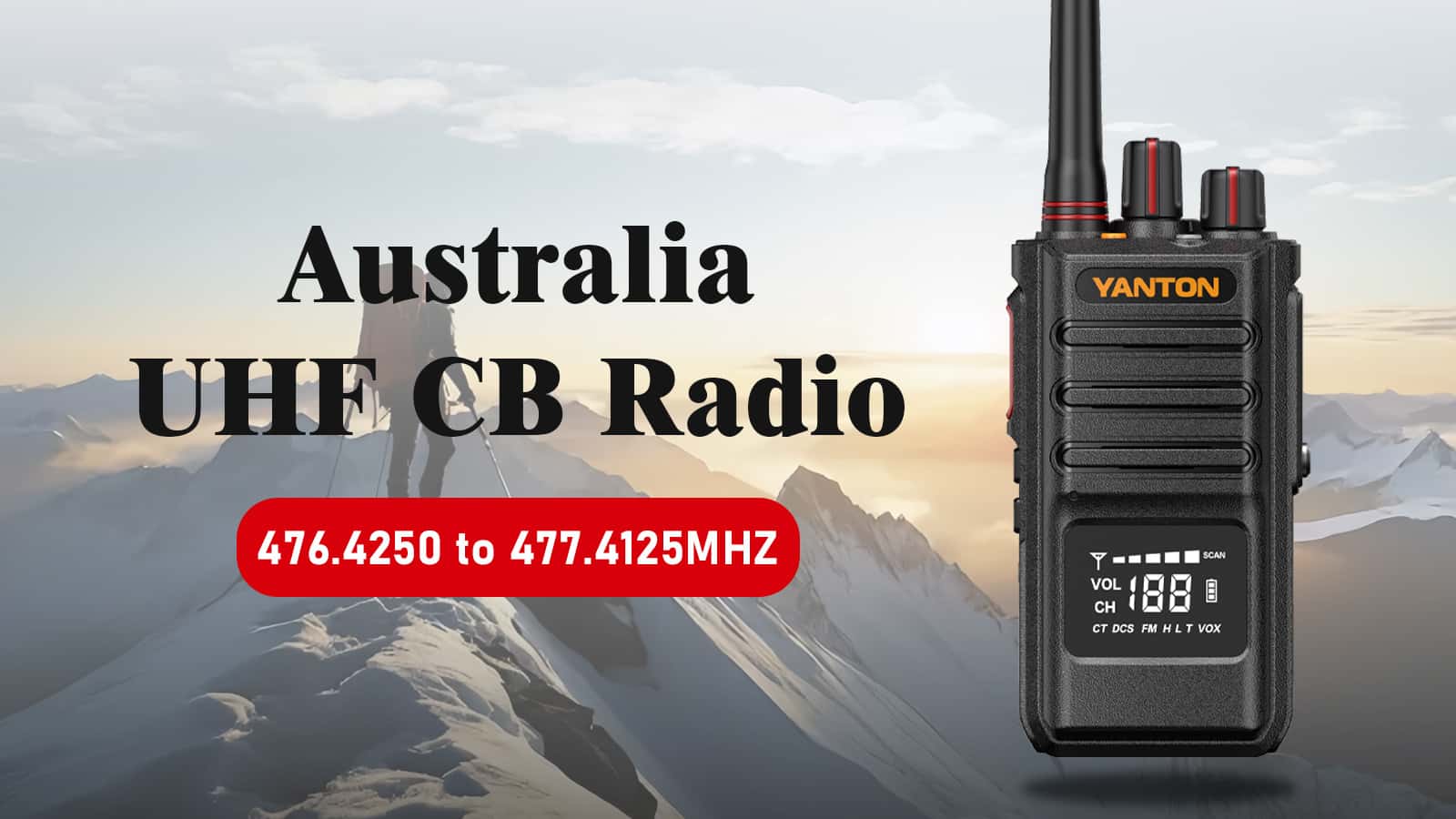
Citizen Band Facts The Citizen Band Radio Service (CBRS) is a two-way, short distance, voice communications service that can be used by any person in Australia. CB radios provide a cheap and reliable means of communications. UHF CB Radio is a license-free, short-range, two-way radio communication system that operates on UHF frequencies. Think of it as a "walkie-talkie network for adults" used primarily in vehicles, workplaces, and outdoor settings. How It Differs From Other Radios: VS Cell Phones: No towers needed, works anywhere, but shorter range VS Old CB Radios: UHF (476-477 MHz) vs. older 27 MHz systems - UHF is clearer and better in cities VS Professional Radios: Cheaper and no license needed, but less powerful There are 80 Channels of free UHF CB Two Way Radio Channels that have been set aside for the general public to use. These frequencies are in the UHF Band between 476.4250 and 477.4125 MHz. Any frequencies outside of this band are for COMMERCIAL USE ONLY and all need to be licenced. Channel Frequency Use 1 476.4250 Duplex – Repeater Output 2 476.4500 Duplex – Repeater Output 3 476.4750 Duplex – Repeater Output 4 476.5000 Duplex – Repeater Output 5 476.5250 Duplex – Repeater Output – (Emergency Use Only) 6 476.5500 Duplex – Repeater Output 7 476.5750 Duplex – Repeater Output 8 476.6000 Duplex – Repeater Output 9 476.6250 Simplex – General Use 10 476.6500 Simplex – 4WD Drivers, Convoys, Clubs & National Parks 11 476.6750 Simplex – Call Channel 12 476.7000 Simplex – General Use 13 476.7250 Simplex – General Use 14 476.7500 Simplex – General Use 15 476.7750 Simplex – General Use 16 476.8000 Simplex – General Use 17 476.8250 Simplex – General Use 18 476.8500 Simplex – Caravan & Camper Convoy Channel 19 476.8750 Simplex – General Use 20 476.9000 Simplex – General Use 21 476.9250 Simplex – General Use 22 476.9500 Data Only (No Voice – No Packet) 23 476.9750 Data Only (No Voice – No Packet) 24 477.0000 Simplex – General Use 25 477.0250 Simplex – General Use 26 477.0500 Simplex – General Use 27 477.0750 Simplex – General Use 28 477.1000 Simplex – General Use 29 477.1250 Simplex – Pacific Hwy (NSW), Bruce Hwy (QLD) – Road Channel 30 477.1500 Simplex – UHF CB Broadcasts 31 477.1750 Repeater Input 32 477.2000 Repeater Input 33 477.2250 Repeater Input 34 477.2500 Repeater Input 35 477.2750 Repeater Input – (Emergency Use Only) 36 477.3000 Repeater Input 37 477.3250 Repeater Input 38 477.3500 Repeater Input 39 477.3750 Simplex – General Use 40 477.4000 Simplex – Highway Channel 41 476.4375 Duplex – Repeater Output 42 476.4625 Duplex – Repeater Output 43 476.4875 Duplex – Repeater Output 44 476.5125 Duplex – Repeater Output 45 476.5375 Duplex – Repeater Output 46 476.5625 Duplex – Repeater Output 47 476.5875 Duplex – Repeater Output 48 476.6125 Duplex – Repeater Output 49 476.6375 Simplex – General Use 50 476.6625 Simplex – General Use 51 476.6875 Simplex – General Use 52 476.7125 Simplex – General Use 53 476.7375 Simplex – General Use 54 476.7625 ...
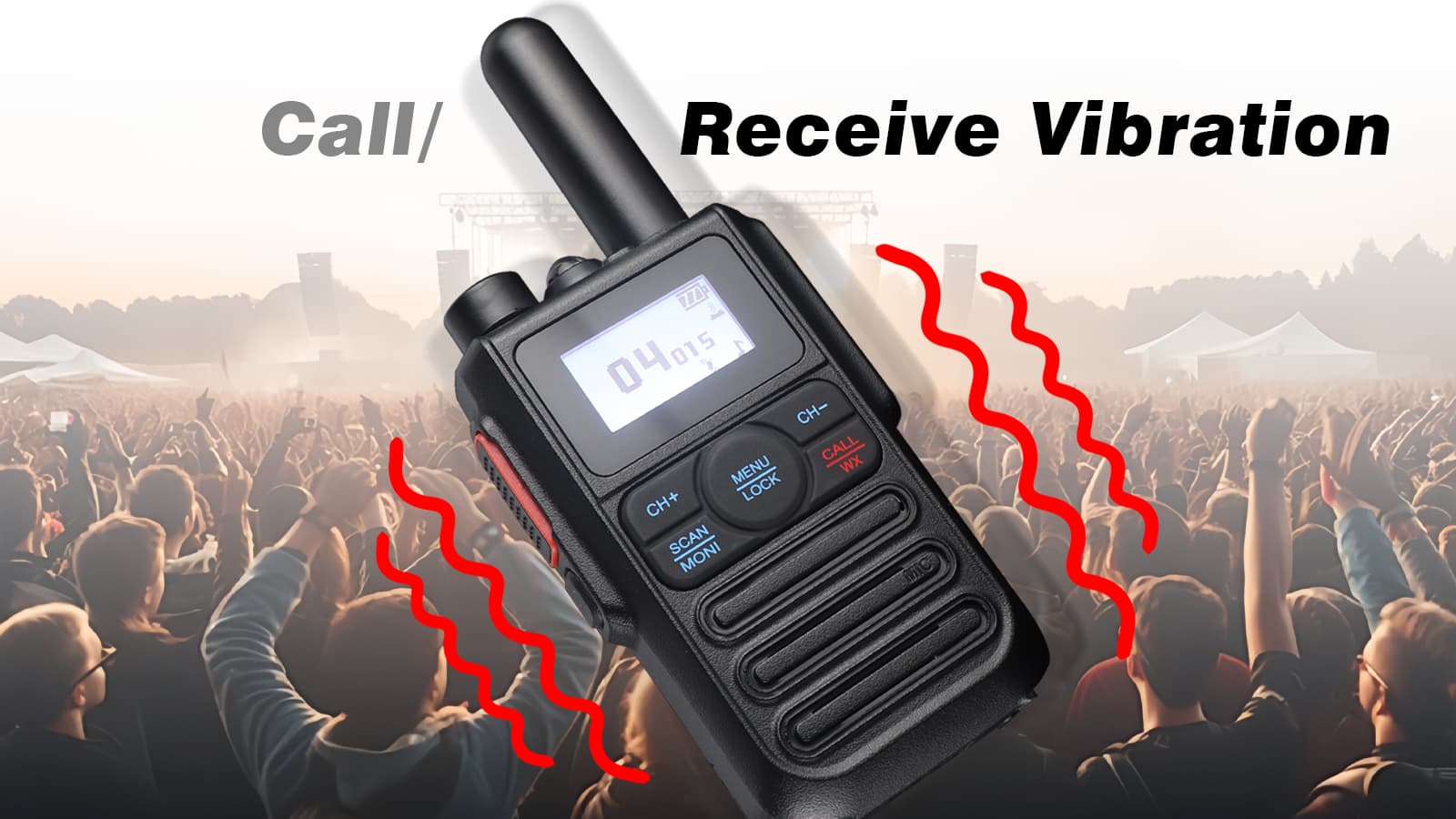
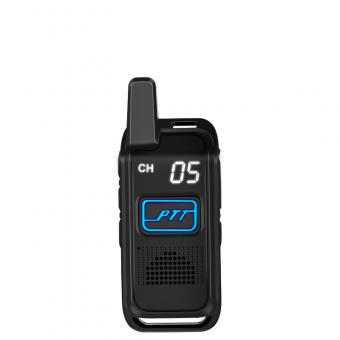
What is "Call Vibration" on a Walkie-Talkie? Call Vibration (often called Vibrate Alert or Vibra-Call) is a feature on many modern walkie-talkies that causes the device to vibrate silently when it receives an incoming call (transmission) from another unit in your group. It works exactly like the vibrate mode on your mobile phone. How Does It Work? Incoming Signal: Someone in your group presses the Push-to-Talk (PTT) button on their walkie-talkie. Activation: Your walkie-talkie, set to the same channel and privacy code (CTCSS/DCS), receives the signal. Vibration Alert: Instead of (or in addition to) an audible ringtone, a small motor inside your walkie-talkie activates, making the device vibrate. Your Action: You feel the vibration, know someone is calling, and you can then press your PTT button to respond. Why is This Feature So Important? The vibrate function is crucial in situations where sound is a problem: Noisy Environments: On a construction site, in a factory, at a loud concert, or in a busy warehouse, you might not hear the call alert tone. A vibration is much easier to feel. Quiet/Stealth Environments: In a library, during a meeting, in a hospital, on a security patrol, or while hunting, an audible alert would be disruptive or counterproductive. Vibration allows for silent communication. Discretion: It allows you to receive a call without drawing attention to yourself or interrupting others nearby. Confirmation: It provides a physical confirmation that your group's channel is active and someone is trying to reach you, even if you momentarily miss the audio.
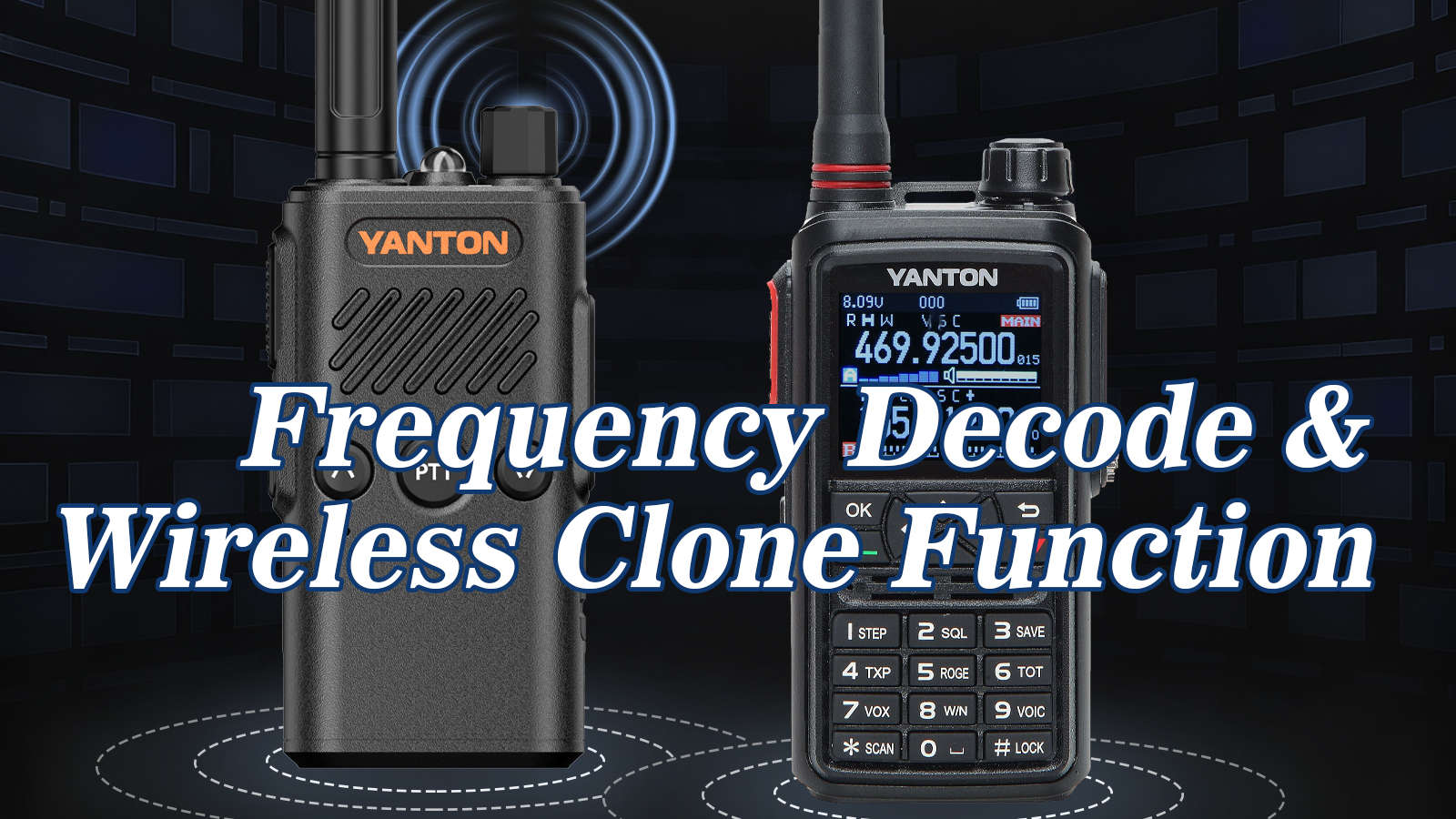
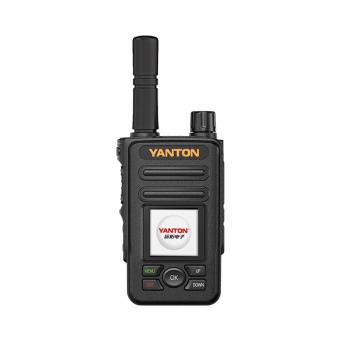
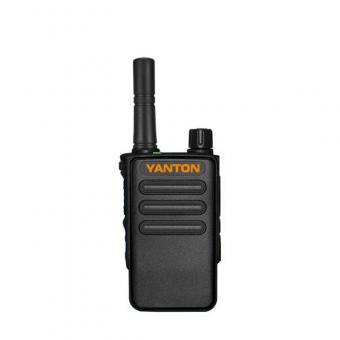
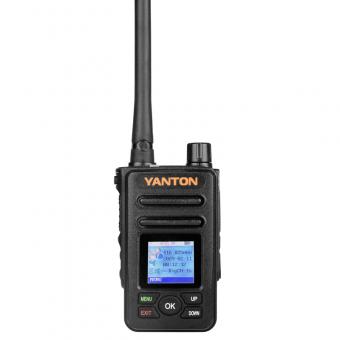
These are two distinct but related functions found in some advanced walkie-talkies (like YANTON T-U8 radio and T-360UV) that allow you to gather intelligence and replicate settings from other radios. Frequency Decode: Is the "Listen and Identify" function. Wireless Clone: Is the "Copy and Paste" function. 1. Frequency Decode What it is: This is a feature that allows the walkie-talkie to listen to a radio signal and determine the exact frequency on which that signal is being transmitted. How it Works: 1. Set Radio A (receiver) to Channel 1 and turn it off. 2. Press and hold Side Button 1 on Radio A (receiver) while it is powered on. The radio will automatically announce "Entering Frequency Measurement Mode" and end with a beep. 3. Position Radio B (transmitter) approximately 1 meter from the Radio A. Press and hold the PTT button on Radio A (receiver) to transmit. The Radio A (receiver) will announce "Frequency Measurement Successful" and automatically save the channel. Radio A (receiver) and B (transmitter) can now communicate normally on the current channel. 4. Switching to another channel is similar to the above steps. Switch Radio A (receiver) to another channel, and Radio B (transmitter) will also switch channels. Press and hold the PTT button on Radio B (transmitter) to transmit. The Radio A (receiver) will announce "Frequency Measurement Successful" and automatically save the channel. Radio A (receiver) and B (transmitter) can now communicate normally on the current channel. 2. Wireless Clone What it is: This is a function that allows you to copy all the programming settings from one walkie-talkie to another of the same model, without using a computer or a cable. It transmits the configuration data wirelessly via radio signal. How it Works: 1. Set Radio A (receiver) to Channel 2 and power off. 2. On Radio A (receiver), press and hold side button 1 and power on. After hearing the "Team Receive" tone, the transceiver enters the wireless cloning function; the current indicator light turns blue. 3. Set Radio B (transmitter) to Channel 2 and power off. 4. On Radio B (transmitter), simultaneously press and hold side button 1 and the PTT transmit button and power on. The voice prompt "Team Receive" will sound, and the current indicator light turns red. 5. After a few seconds, both Radio A (receiver) and Radio B (transmitter) will automatically announce the current channel "2," indicating that the two radios have successfully teamed up. The two radios can now communicate. Summary Table Feature Primary Function How It Works Common Use Case Frequency Decode Identify & Discover Listens to a transmission and displays its frequency. Finding unknown channels for listening. Wireless Clone Copy & Duplicate Transmits configuration data from one radio to others. Bulk programming a fleet of radios quickly.
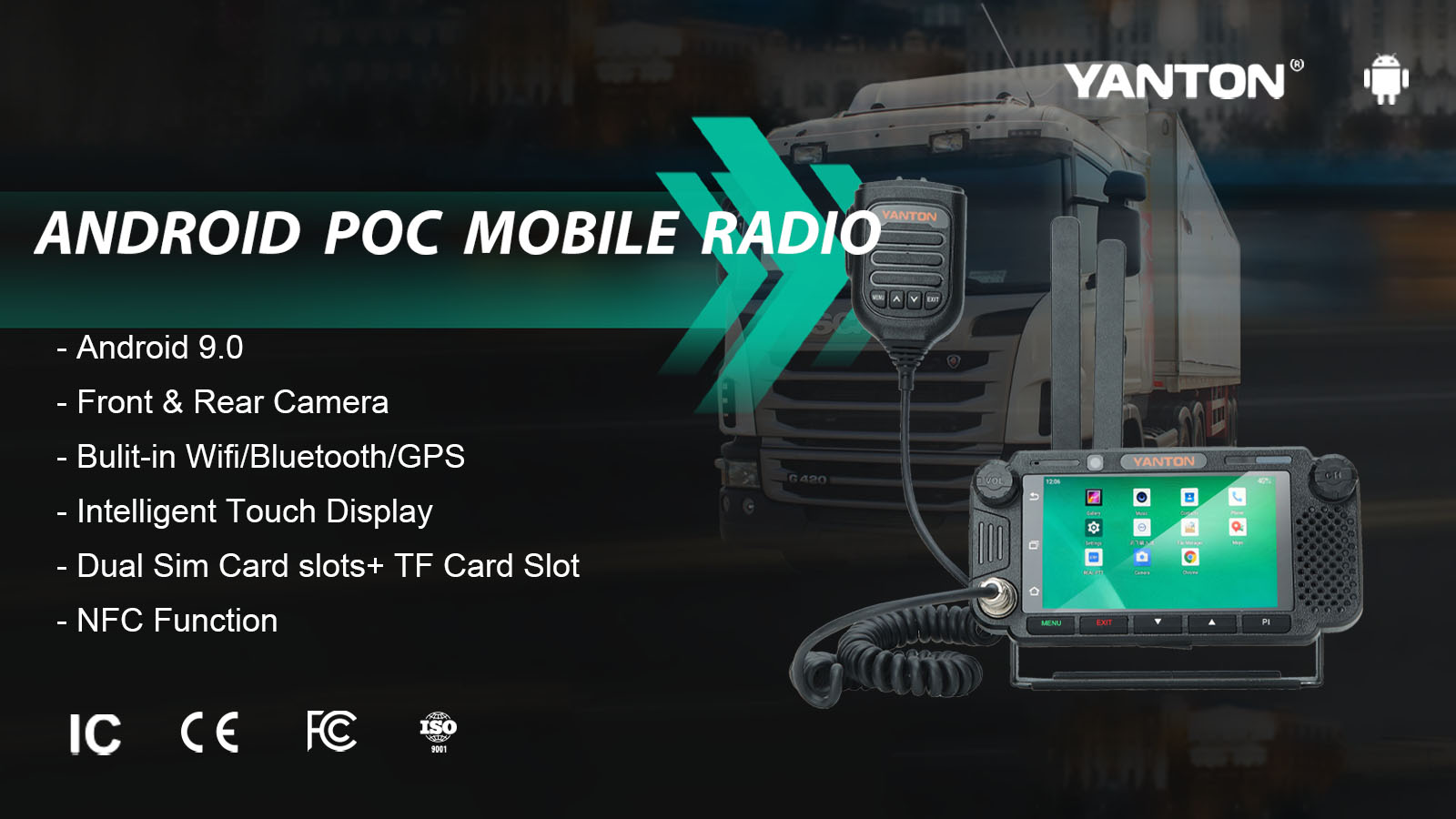
The TM-7600 is a Push-To-Talk over Cellular (PoC) mobile radio designed for in-vehicle communication. With YANTON innovative design, it provides reliable, loud & clear voice service for various field communication scenarios. Smooth Communication Compared with regular smartphone, the external LTE antennas on the 7600 improve its RX sensitivity. The manual switch enables the 7600 radio to always select the network with stronger signal strengths. Loud and Clear Voice The built-in 5watt speaker comes with distortion suppression, howling suppression and noise cancellation technology, which enables the 7600 to transmit loud and clear audio even with the window rolled down in construction sites or bustling street. Flexibility and Adaptability Paring with rich accessories, the 7600 gives more freedom and flexibility for voice communications. With the Android system and standard APIs, the 7600 is open for third-party apps to create an in-vehicle ecosystem for data application in the field. Robust Design, Easy to Use Compact and lightweight, the 7600 perfectly fits into the limited space in the vehicle of almost all types. Aviation connector between remote microphone and main unit, robust design to provide reliable and stable connection under any operation scenarios.
In celebration of the 76th Anniversary of the Founding of the People's Republic of China, we will observe a holiday from 1st to 6th October 6th. For any urgent matters, please contact YANTON sales team; we will do our best to assist you.
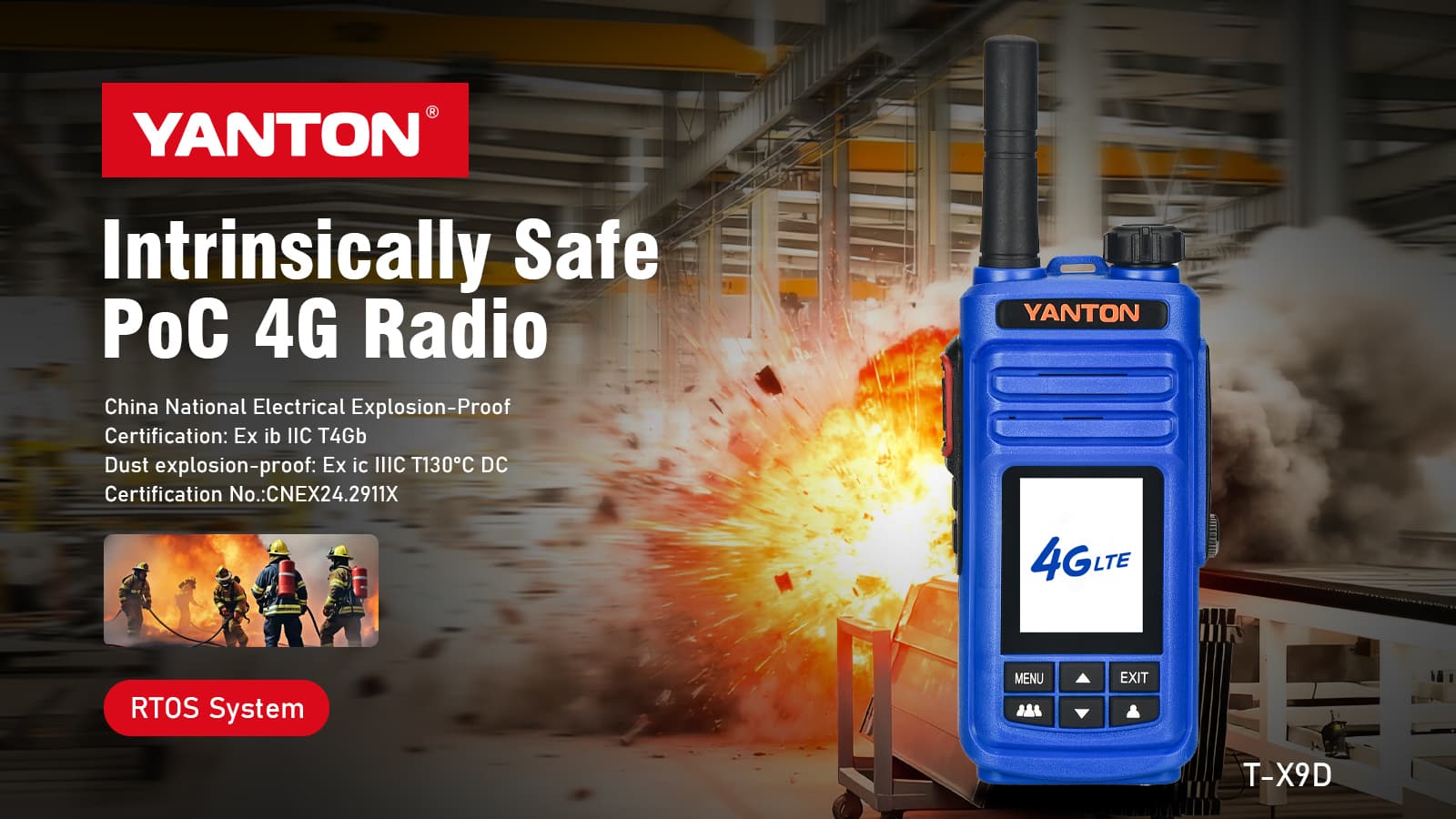
Explosion-Proof (Hazardous Location Rating) An explosion-proof rating means the device's enclosure is designed to: Contain an Internal Explosion: If a spark from the device's internal components (e.g., the battery, circuitry) ignites flammable gases or dusts that have seeped inside, the enclosure is strong enough to contain the explosion without rupturing. Prevent Ignition of External Atmosphere: The joints and flanges of the enclosure cool any hot gases escaping from inside so that they are not hot enough to ignite the surrounding flammable atmosphere. Operate Safely at Surface Temperatures: The exterior of the device will not get hot enough to become an ignition source itself. This is crucial in industries where flammable gases, vapors, liquids, or dusts are present. Common Standards and Certifications: ATEX (Europe): Directive 2014/34/EU. A device might be rated for Zone 1 (high risk) or Zone 2 (lower risk). IECEx (International): A global certification system. UL (North America): Class I, Division 1 (hazardous gases present normally) or Division 2 (hazardous gases present abnormally). GB(China's standard system): GB 3836 series of standards. Explosion-Proof PoC Radio: An Explosion-Proof PoC Radio is a rugged, wireless communication device that is: 1. Certified for use in hazardous environments (like oil refineries, chemical plants, grain silos, mining operations, paint booths, and gas utilities) where flammable substances are present. 2. Uses public cellular networks to provide instant push-to-talk voice communication, GPS location tracking, and data messaging over a very wide area. It is essentially a professional-grade, intrinsically safe Smartphone /walkie-talkie hybrid built for the most dangerous workplaces. Key Benefits and Use Cases: Safety: The primary benefit. It allows for critical communication in volatile areas without being a source of ignition. Extended Range: Workers on a large refinery site, pipeline right-of-way, or remote mining operation can stay connected far beyond the range of a traditional radio system. Enhanced Coordination: Supervisors can instantly communicate with teams spread across different locations and track their precise GPS location for safety and efficiency. Cost-Effective: Eliminates the need to build and maintain a private land mobile radio (LMR) network like a trunked radio system. In conclusion, an explosion-proof PoC radio is a vital tool for ensuring both safe operation and effective communication in industries where the combination of explosive atmospheres and wide-area operations is a daily challenge. Explosion-Proof (Hazardous Location Rating) An explosion-proof rating means the device's enclosure is designed to: Contain an Internal Explosion: If a spark from the device's internal components (e.g., the battery, circuitry) ignites flammable gases or dusts that have seeped inside, the enclosure is strong enough to contain the explosion without rupturing. Prevent Igni...
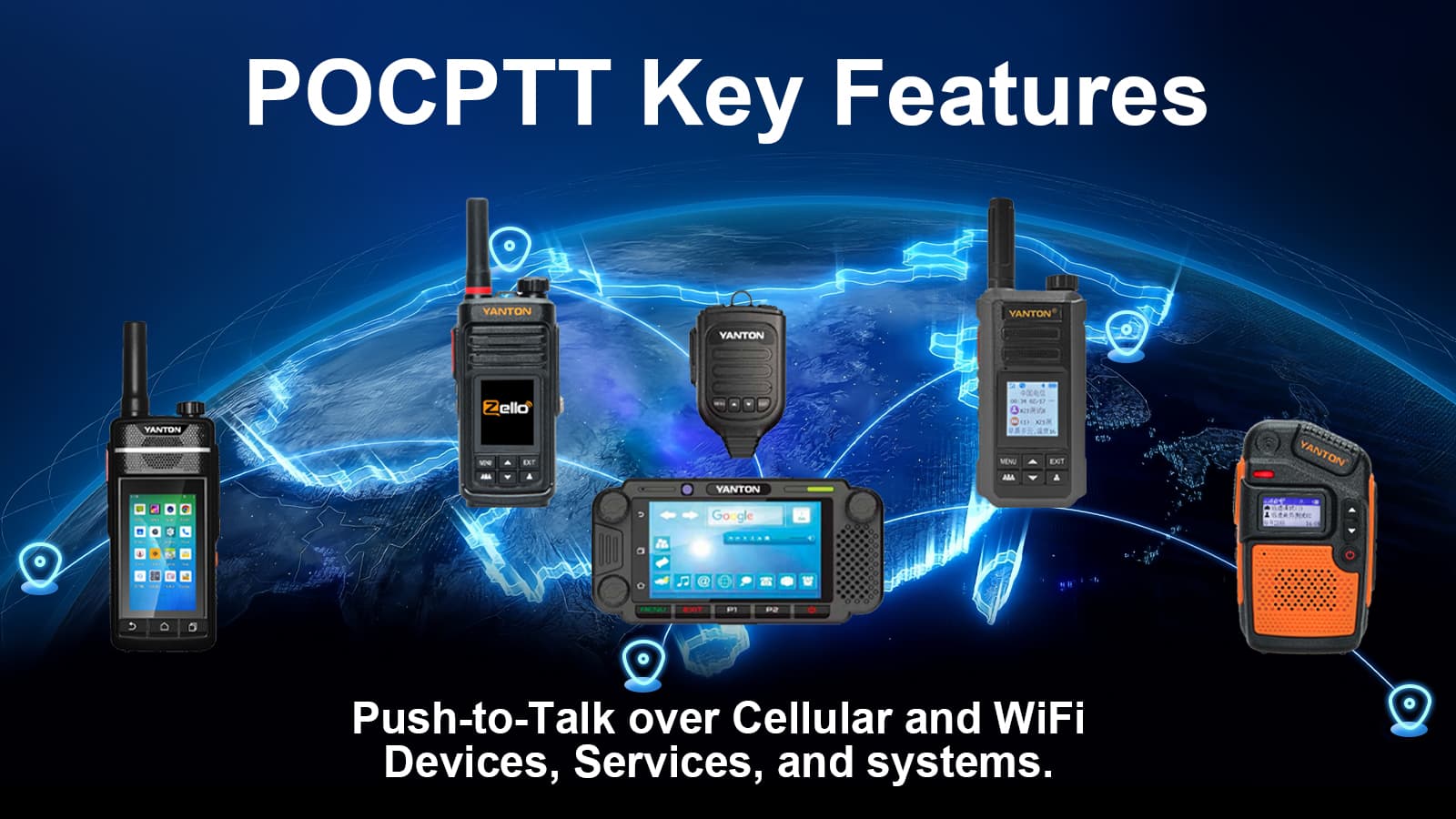
1. GPS (Global Positioning System) Allows the device to determine and report its precise geographic location (longitude and latitude) in real-time. 2. Recording The function to record audio, either from conversations or the environment. This can include recording both sides of a conversation. 3. Positioning The system that utilizes GPS to track and monitor the location of the device and its user on a digital map. This is often managed through a backend platform. 4. Geo-fence A virtual geographic boundary. The administrator can set up allowed or restricted areas on the map. The system will generate an alert (e.g., send a notification) when the device enters or exits these predefined areas. 5. SOS An emergency function. By pressing a dedicated SOS button, the device immediately sends a distress signal along with its current location to pre-set contacts or a monitoring center, requesting urgent help. 6. Voice-features The device uses synthesized voice to announce status, such as power on/off, channel switching, low battery, etc.
Please read on, stay posted, subscribe, and we welcome you to tell us what you think.
 YANTON Building,Creation Road Tuoxing Industrial,Optoelectronics-information industry base,xiamei town,Nan'an City ,Fujian Province, China. / Room 2105 XM1507 Trend Center 29-31 Cheung , Lee Street Chai Wan,Hongkong
 86-592-5798082
86-595-86767398
86-592-5798082
86-595-86767398
 86-595-86761298


© Copyright: 2026 QUANZHOU YANTON ELECTRONICS CO., LTD. All Rights Reserved.

IPv6 network supported