Can YANTON radios be connected to a public network PoC platform?
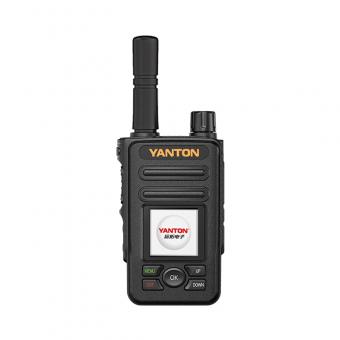
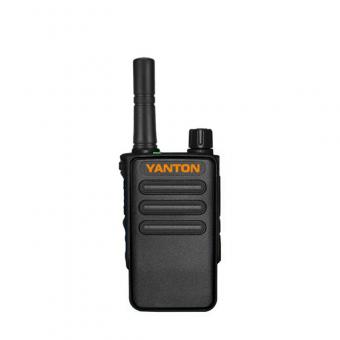
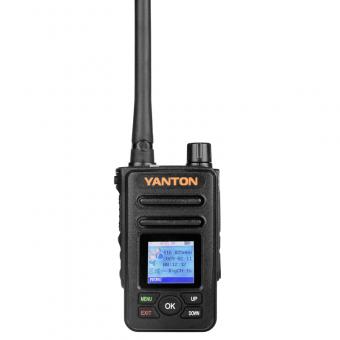
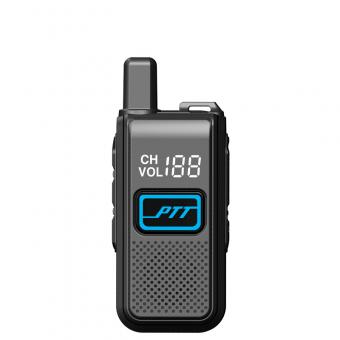
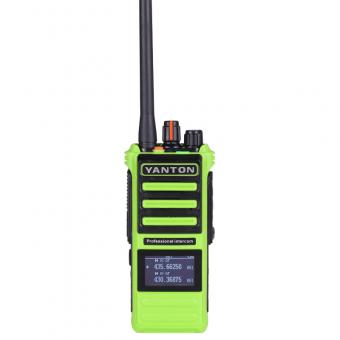
- Yes, but only through YANTON’s PoC-capable models, not through standard DMR handhelds. YANTON produces dedicated PoC radios that operate over 4G/LTE or WiFi, including the T-X8 (compatible with REAL PTT) and the DM-868PLUS (a hybrid PoC + DMR/analog device). The DM-868PLUS specifically functions as a gateway: it can route communications between PoC users on the cellular network and DMR/analog users on a local radio system, either automatically or via manual priority selection. A standard YANTON DMR radio (e.g., DM-980, DM-369) does not have native PoC connectivity; bridging it to a public PoC platform requires a gateway device such as the DM-868PLUS or a comparable cross-band solution.
Do YANTON radios support third-party dispatch software or management platforms?
- YANTON PoC radios (e.g., T-X8) are documented as compatible with the REAL PTT platform, allowing real-time location tracking through a dispatch console. YANTON also offers its own PoC dispatch solution with GPS tracking, private/group/all calls, dynamic regrouping. YANTON’s programming software is the primary management tool for conventional DMR fleets. Integration with a third-party DMR dispatch platform would require the platform to support the specific YANTON radio’s programming/protocol interface, which should be confirmed on a case-by-case basis.
How can multiple repeaters be IP-connected for remote networking?
- YANTON’s publicly documented solutions focus on PoC over cellular networks rather than IP-linked DMR repeater networking. For DMR multi-repeater IP linking, the industry-standard approach (used by infrastructure vendors like Kirisun and Hytera) is to connect repeaters over an IP network so that talkgroups span geographically separated sites. Each site retains local repeater operation if the backhaul fails, while the IP link carries traffic between sites. If you require this architecture with YANTON DMR repeaters, you must verify whether the specific repeater model includes an IP networking or SIP gateway interface.
Can YANTON radios connect to an existing trunking or dispatch system?
- This depends on the system type and YANTON model. YANTON’s DMR portfolio is primarily Tier I / Tier II conventional DMR. Direct integration into a third-party Tier III trunking system is not a standard published capability for the DMR handheld line. For dispatch integration, YANTON offers its own PoC dispatch ecosystem, and certain PoC models (like the DM-868PLUS) feature a CROSS BAND gateway that bridges PoC (4G/5G) and DMR/analog systems, allowing DMR radios to be linked into a broader dispatch environment through that gateway. For direct connection to an existing third-party DMR trunking infrastructure, you should confirm the specific model’s firmware and gateway capabilities with YANTON or a dealer.
What conditions must be met for DMR interoperability (frequency, color code, time slot, encryption)?
- For two DMR radios to communicate directly or through the same repeater, the following parameters must match: Frequency and Channel Spacing: Both radios must be programmed to the same transmit and receive frequencies, with matching channel spacing (typically 12.5 kHz for digital). Color Code (CC): The color code acts as a system identifier. Both radios must use the same color code value to access the same repeater or talkgroup. Time Slot: For Tier II conventional DMR, both radios must transmit and receive on the same time slot (Slot 1 or Slot 2) for a given channel. Talkgroup / Contact: The digital contact (group call, private call, or all call) must be configured identically on both ends. Encryption: If encryption is enabled on one radio, the other must support the same encryption algorithm (e.g., AES256) and share the identical encryption key. If encryption is not used on either side, this condition is moot.
Can YANTON DMR radios interoperate with DMR radios from other brands?
- Yes, subject to configuration alignment. YANTON DMR radios are built to the ETSI DMR standard (Tier I & Tier II), and third-party product listings explicitly note compatibility with Motorola Tier I & Tier II systems for models such as the DM-980. Interoperability is not automatic out of the box; it requires matching the core DMR parameters between the YANTON radio and the third-party radio.
For a small or medium business, which should they choose among analog, digital, and PoC?
- The answer depends on the specific operational profile. Analog remains adequate only for very small teams with minimal range requirements and no need for data features—but it is a declining path with limited upgrade potential. DMR is the appropriate choice for businesses operating on a defined site (warehouse, factory, campus, hotel) where the organization can control coverage and values reliability independent of carrier networks; the initial investment in licensed infrastructure is offset by doubled capacity and long equipment lifecycle. PoC suits businesses whose staff are dispersed across routes or multiple locations where cellular coverage is already dependable, and where avoiding infrastructure costs matters more than network independence. For most SMEs with a fixed primary site and moderate growth expectations, DMR Tier II offers the best balance of control, cost-effectiveness, and future capability.
How should one choose between PoC and DMR?
- The decision depends primarily on coverage footprint and infrastructure control. Choose PoC when the team is distributed across multiple cities or regions, cellular coverage is reliable at all operating locations, and rapid deployment without building repeater infrastructure is a priority. Choose DMR when the organization needs full control over its communication network, operates in environments without reliable cellular coverage (remote sites, underground facilities, metal-walled buildings), or requires guaranteed availability during network outages. A hybrid approach—using DMR for on-site coverage and PoC for dispersed teams—is viable when both conditions coexist and interoperability between the two systems is required, like YANTON DM-868PLUS, PoC+DMR dual mode radio.


 English
 русский
 español
 português
 العربية
 China






 YANTON Building,Creation Road Tuoxing Industrial,Optoelectronics-information industry base,xiamei town,Nan'an City, Fujian Province, China, 362302.
 86-592-5798082
86-595-86767398
 86-595-86761298